

While today might be just another regular weekday on some people’s calendars, for a growing number of devoted enthusiasts, including us at Inkstable, it is a special day as we celebrate World Calligraphy Day.
Calligraphy has accompanied writing culture for centuries, developing into distinct traditions across different parts of the world. In the West, its roots reach back into classical antiquity, with Roman lettering becoming an important foundation for many of the scripts that followed. Etymologically, the word calligraphy comes from the Greek kallos, meaning “beauty”, and graphein, meaning “to write”. In other words, beautiful writing. And perhaps no two words could describe it better.

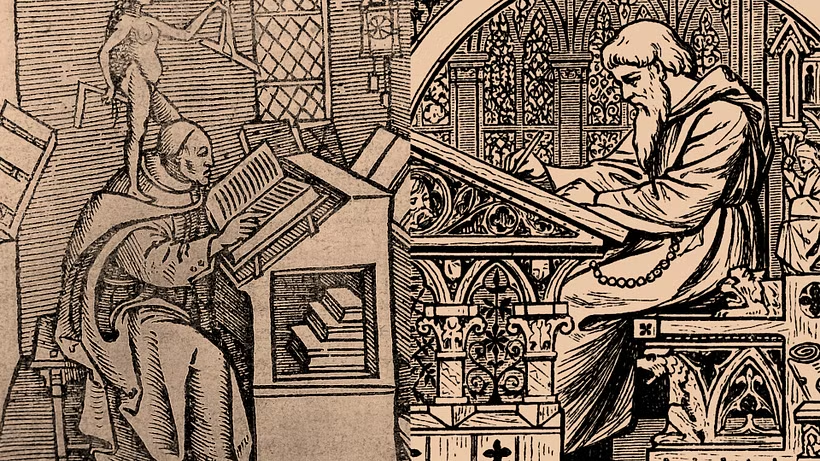
Over the centuries, this art (because it really is one) has been practised, refined and passed down from one generation to the next. Styles and tools may have changed slightly, but its essential purpose has remained the same: giving greater beauty and expression to the written word.
Today’s article is about celebrating this centuries-old tradition, the people who continue to practise it and, perhaps most importantly, why it is still worth keeping alive at a time when we are increasingly being promised a future of complete digitalisation, automation and AI.
So, Where Did It All Begin?
There is no single birthplace or history of calligraphy. Chinese, Arabic, Japanese and Western calligraphic traditions developed in different cultural and historical contexts, each with their own tools, techniques and ideas about beautiful writing.
Since here at Inkstable we spend most of our time around fountain pens and the Latin alphabet, we’ll keep our brief journey focused mainly on the Western tradition.
Its roots can be traced back to the classical world. In Ancient Rome, carefully constructed capital letters appeared on monuments and inscriptions, while other forms of writing were developed for manuscripts and everyday communication. Roman Capitals, Rustic Capitals and various forms of Roman Cursive would all contribute to the long development of Western letterforms.


As writing culture evolved, so did the scripts. Uncial, recognisable by its broad, rounded forms, became an important book hand in Late Antiquity and the early medieval period and was widely used for Christian manuscripts.
By the late 8th and 9th centuries, Carolingian minuscule was being developed and promoted during the Carolingian Renaissance. Its relatively clear, regular, and widely spaced letterforms made texts easier to read and helped standardise writing across much of Western Europe.
Later medieval scribes developed the denser and more angular scripts we broadly associate with Gothic or Blackletter. These styles became particularly prominent in European manuscript culture during the later Middle Ages.


The Renaissance brought another transformation. Italian humanists looked back towards earlier manuscripts and classical culture, helping give rise to Humanist and Italic hands. Chancery writing, with its elegant rhythm and characteristic slant, would become particularly influential on later Western calligraphy.
The history is much more complicated than one script simply replacing another. Styles overlapped, changed from region to region and continued to evolve alongside one another. But together, they created much of the visual vocabulary Western calligraphers still draw upon today.
From Gothic to Copperplate and Everything in Between
Many historical styles remain alive in contemporary calligraphy.
Gothic or Blackletter is immediately recognisable through its strong, angular forms and dramatic contrast. On the other hand, Italic tends to feel lighter and more fluid, characterised by its rhythm and slant. Copperplate, which emerged much later, is associated with pointed-pen writing and is known for its fine hairlines and contrasting shaded strokes.
Then there is modern calligraphy, a much broader category in which calligraphers often borrow traditional tools and techniques without adhering strictly to a historical script.
And that isn’t necessarily a departure from tradition. Calligraphy has never been completely static. Letterforms have continually evolved as writers, materials, technologies and tastes have changed.
The tools available to today’s calligrapher are equally diverse. Broad-edge and pointed dip nibs remain fundamental to many traditional Western styles, while fountain pens, brush pens, markers and digital tools have made lettering and calligraphy accessible to an even wider audience.
Perhaps technology hasn’t killed calligraphy after all. In some ways, it has given more people an opportunity to discover it.


The People Keeping the Nib Moving
But a tradition only survives because somebody chooses to continue it.
Today, that happens through professional calligraphers, teachers and countless enthusiasts who practise the craft and share their knowledge and passion with others.
One of the most recognisable contemporary examples is British artist and calligrapher Seb Lester. Trained in graphic design and formerly a senior type designer at Monotype, Lester has built an enormous international audience around his fascination with letterforms. According to his official biography, he became the first calligrapher in his field to surpass one million followers on social media. His client list has included Montblanc, Apple, NASA, Nike and The New York Times.


His popularity illustrates something important about calligraphy today: a centuries-old craft can find an entirely new audience through very modern means.
Social media has allowed a beautifully executed letter or calligraphy demonstration to travel around the world in seconds. Someone who might never have encountered a professional calligrapher can watch one work, become curious about the technique and eventually pick up a pen themselves.
World Calligraphy Day is itself part of this effort. The celebration was founded by the British Manuscript Pen Company in 2017 to bring together experts and beginners to practise, learn, discuss and celebrate calligraphy and creative lettering. The first World Calligraphy Day was held on 16 August 2017, with workshops and demonstrations taking place at Birmingham’s Pen Museum and elsewhere.
The date changes from year to year, and this year World Calligraphy Day falls on Wednesday, 12 August.
Beauty Is Not Everything
There is another reason to keep calligraphy alive, and it has little to do with how beautiful the finished page looks.
Calligraphy demands something increasingly scarce: our attention, which seems to be shrinking by the day. Writing by hand requires the brain and hand to work together in ways that typing does not, and research suggests it may support processes involved in learning, memory and concentration. Calligraphy takes this a step further, asking us to pay attention to pressure, movement, spacing and proportion and, perhaps most importantly, to slow down and be patient throughout the process.


Why Calligraphy Matters More Than Ever
Computers have already eliminated much of the practical need for beautiful handwriting. Now AI can produce paragraphs, emails, invitations and entire documents in seconds. But efficiency isn’t everything.
The easier it becomes to create something digitally, the more meaningful something deliberately made by hand can feel. A calligraphed word carries the small variations of the person who created it: changes in pressure, the flow of the ink and the occasional imperfect stroke. These aren’t necessarily flaws. In fact, I like to see them as proof that a human hand was there.
And that is exactly why calligraphy is worth keeping alive.

Like any traditional craft, it cannot survive on admiration alone. It needs to be practised. Every page filled by a beginner, every technique passed from a calligrapher to a student and every person who decides to pick up a nib contributes, in a small way, to keeping centuries of knowledge alive.
We don’t practise calligraphy because it is the fastest way to write. We practise it because there is pleasure in mastering a difficult stroke, beauty in seeing ink materialise on paper and meaning in doing something that takes a little more effort.
So why not grab a pen and a piece of paper, try your hand at a simple calligraphy style and see how it goes? You can even watch a few videos on YouTube to get a better understanding. And who knows, you might discover that you are, after all, a little calligrapher in the making.
Condividi:
- Share on X (Opens in new window) X
- Share on Facebook (Opens in new window) Facebook
- Share on WhatsApp (Opens in new window) WhatsApp
- Share on LinkedIn (Opens in new window) LinkedIn
- Share on Pinterest (Opens in new window) Pinterest
- Share on Telegram (Opens in new window) Telegram
- Email a link to a friend (Opens in new window) Email