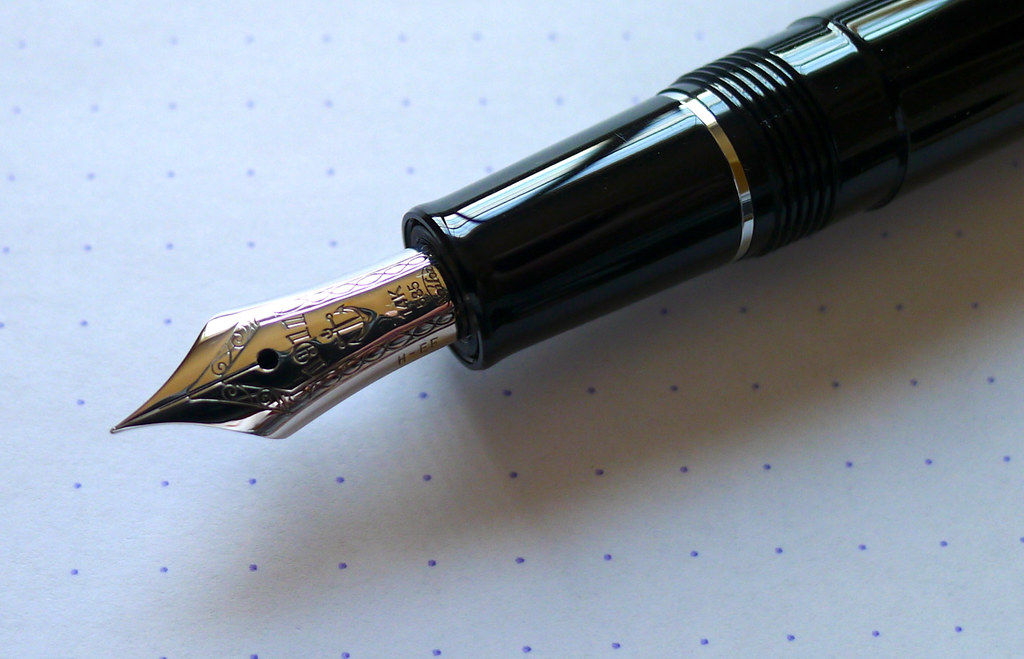
Choosing the right nib is often the most challenging task for many of us, and it’s true that the right nib size can make or break your writing experience. But what exactly is a fine nib useful for? In today’s article, we’ll explore the situations where an extra-fine nib might come in handy and highlight some of the best extra-fine nib options currently available on the market.
Before we go any further, let’s make one thing clear: extra-fine isn’t for everyone. Some people may find it too scratchy — and it often is. Extra-fine nibs don’t always excel in ink flow, and you might miss out on that beautiful ink sheen. However, they are incredibly precise and allow for a wide range of writing styles— including Spencerian, one of my personal favorites. So, what makes an EF nib worth your attention? And which options should you even consider?

Why Choose an Extra Fine Nib?
First off, keep in mind that extra-fine nibs aren’t about showing off bold, inky lines. They require a certain approach and, I’d say, a bit of delicacy too. You’ll still be able to write quickly with one, but don’t expect it to glide across the paper like a medium or broad nib, which almost writes by itself.
Here’s why you might fall in love with an Extra Fine if you decide to get one:
- Precision: Whether you’re jotting down minuscule notes in the margin of a book or sketching fine line details, an EF nib gives you excellent control. It’s perfect for tiny handwriting or very detailed work.
- Paper Versatility: If you like using thinner, or more absorbent paper, an EF nib minimizes bleed-through and feathering. Basically, it behaves nicely even when your notebook doesn’t. Plus it’s great on sticky notes.
- Ink Economy: EF nibs take tiny sips of ink, not big gulps, so you won’t be topping up your pen all the time — a win if you like saving on ink and hate the refill part.
- Clean Look: If you like your handwriting to look clean, tidy, and well-organized, an extra-fine nib could be just what you’re looking for. With the following nibs, you’ll achieve some of the finest strokes possible.

Another important aspect to consider is the quality of the nib. Extra-fine nibs require special care during the manufacturing process to ensure they glide smoothly across the paper rather than scratch it. Below, we’ve put together a selection of some of the best extra-fine nibs.
Extra Fine Nib Options Worth Considering
- Platinum 3776 Century (Ultra Extra Fine – UEF)
Smoothness Level: sharp and quite scratchy
If you’re after the thinnest possible line without sacrificing legibility, Platinum’s UEF is simply a marvel. It’s ridiculously fine and perfect for tiny writing, especially for jotting down book notes. It might be a bit scratchy for some, but after testing it a few times, I didn’t find it so. - Sailor (EF)
Smoothness Level: pretty smooth with slight feedback
Sailor does extra-fine like nobody else, and while you might experience a bit of feedback, you feel the paper’s texture in a satisfying way. It’s almost like driving a manual car — you’re more connected and engaged. Plus, Sailor’s nib tuning is second to none.

- Pilot (EF)
Smoothness Level: silky with low feedback
The Pilot EF nib is known for its buttery glide across the paper, whether you’re using a Metropolitan or a Custom 823. These nibs maintain the perfect balance between precision and smoothness, with barely any feedback. - LAMY 2000 (EF)
Smoothness Level: smooth with low feedback
German EF nibs are broader than Japanese ones, but the LAMY 2000 offers a super consistent, slightly wetter EF line. Great for those who want an EF that’s not too needle-thin but still crisp. - TWSBI Diamond 580 (EF)
Smoothness Level: moderately smooth with slight feedback
For a budget-friendly but quite remarkable EF, TWSBI is a go-to. Plus, it’s a piston filler, meaning a larger ink capacity—important even if you’re using less ink per word.

Should You Get an Extra Fine Nib?
If you have very small handwriting, use your fountain pens to jot notes in the margins of books or journals, or prefer detailed, precise strokes, then these extra-fine nibs might suit your style perfectly. However, if you lean toward juicy ink flow, shading, and bold, expressive lines, an EF nib might not be your everyday go-to — though having one in your lineup is still a wise move. Sometimes, you need a scalpel, not a paintbrush. If you’re unsure, you can always start with a fine nib and see how it feels, and if you find yourself needing even more precision, moving up to an extra-fine might be the natural next step.
If you already own one, what is in your opinion a great, extra-fine nib to write with?
Condividi:
- Click to share on X (Opens in new window) X
- Click to share on Facebook (Opens in new window) Facebook
- Click to share on WhatsApp (Opens in new window) WhatsApp
- Click to share on LinkedIn (Opens in new window) LinkedIn
- Click to share on Pinterest (Opens in new window) Pinterest
- Click to share on Telegram (Opens in new window) Telegram
- Click to email a link to a friend (Opens in new window) Email


Leave a Reply