It is often said that British manufacturing has seen a significant decline in recent years, particularly on the global stage. Much of our production has moved to the Far East, driven by technical capabilities and lower costs. Consequently, the prevalence of British-made products has dwindled, and many of our celebrated trades have slowly eroded, becoming obsolete or lost entirely.
However, there is a glimmer of hope. We still have a few remaining pen manufacturers in the UK, and the one we are focusing on today is Yard O Led. This historic company has seen many iterative changes throughout its century-long existence. While they remain true to their heritage, and sterling silver is still their core metal—well, almost. To stay relevant, Yard O Led has had to adapt to the times; the era when pure sterling silver could be utilized at their original price points is arguably gone. Instead, brass is now used as a cost-effective alternative—a metal that has been utilized for over a millennium. After speaking with Giles and the team at Yard O Led, they explained that they wanted to produce a pen in the mid-£1,000 region while keeping their brand identity intact.
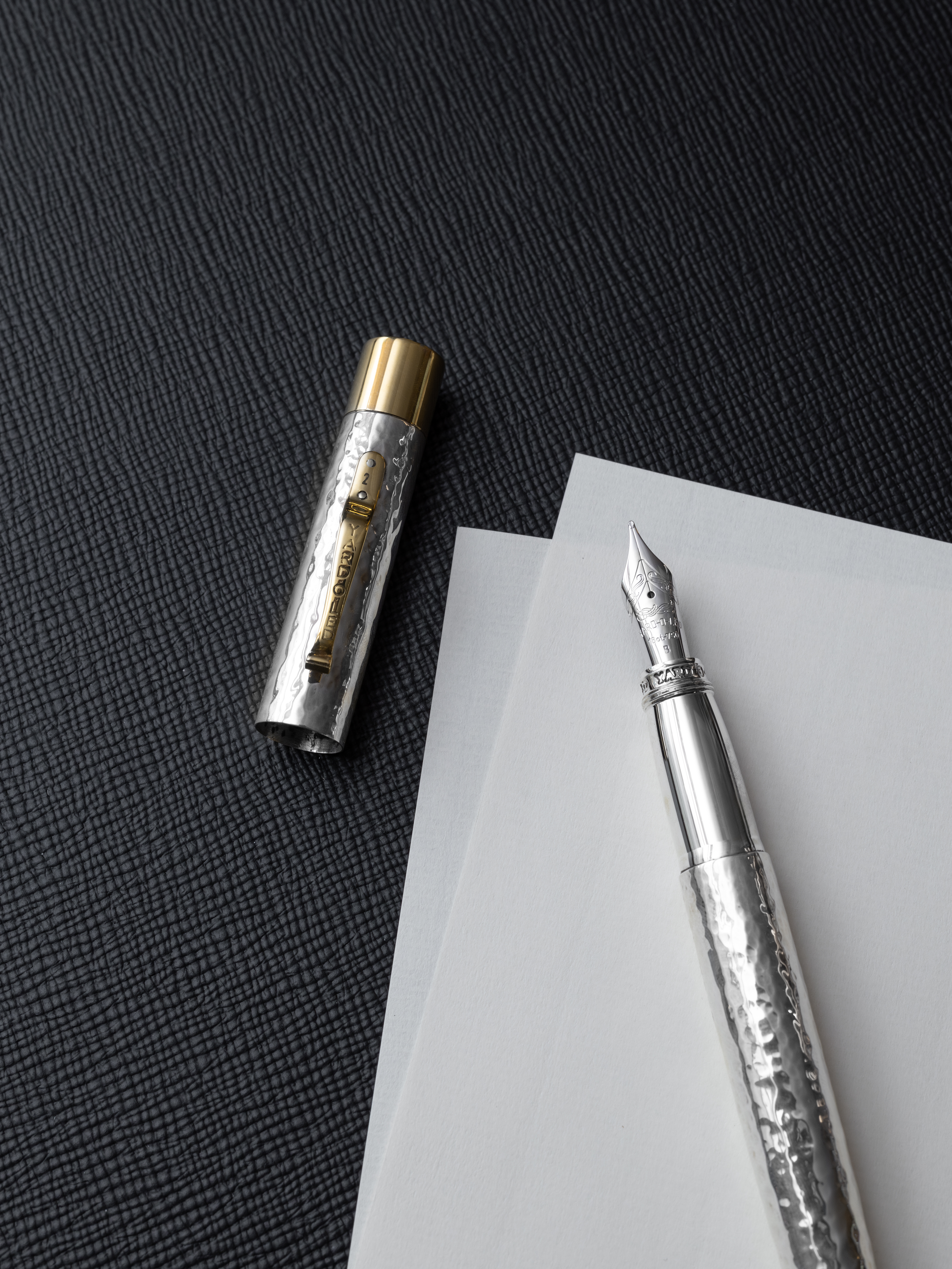
This drive led to the re-release of the Pocket. While the Pocket has been on the market before, it has now been modified to suit the demands of rising material costs. However, the use of brass elements does not diminish its appearance in any way. The highly polished accents are reminiscent of gold, adding a touch of contrast to the pen. The team has also introduced a new feature: three differently coloured enamelled discs, each paired with a unique design.
With this in mind, we now see Yard O Led heading in a new direction—one that is modernising, yet keeps their design philosophy rooted in the past. For me, this is very exciting! It is partly why I wanted to purchase a Pocket from their flagship store in the Piccadilly Arcade in London. This store represents another “first” for the company; until last year, the brand had never operated a boutique in its lifetime… but I digress.

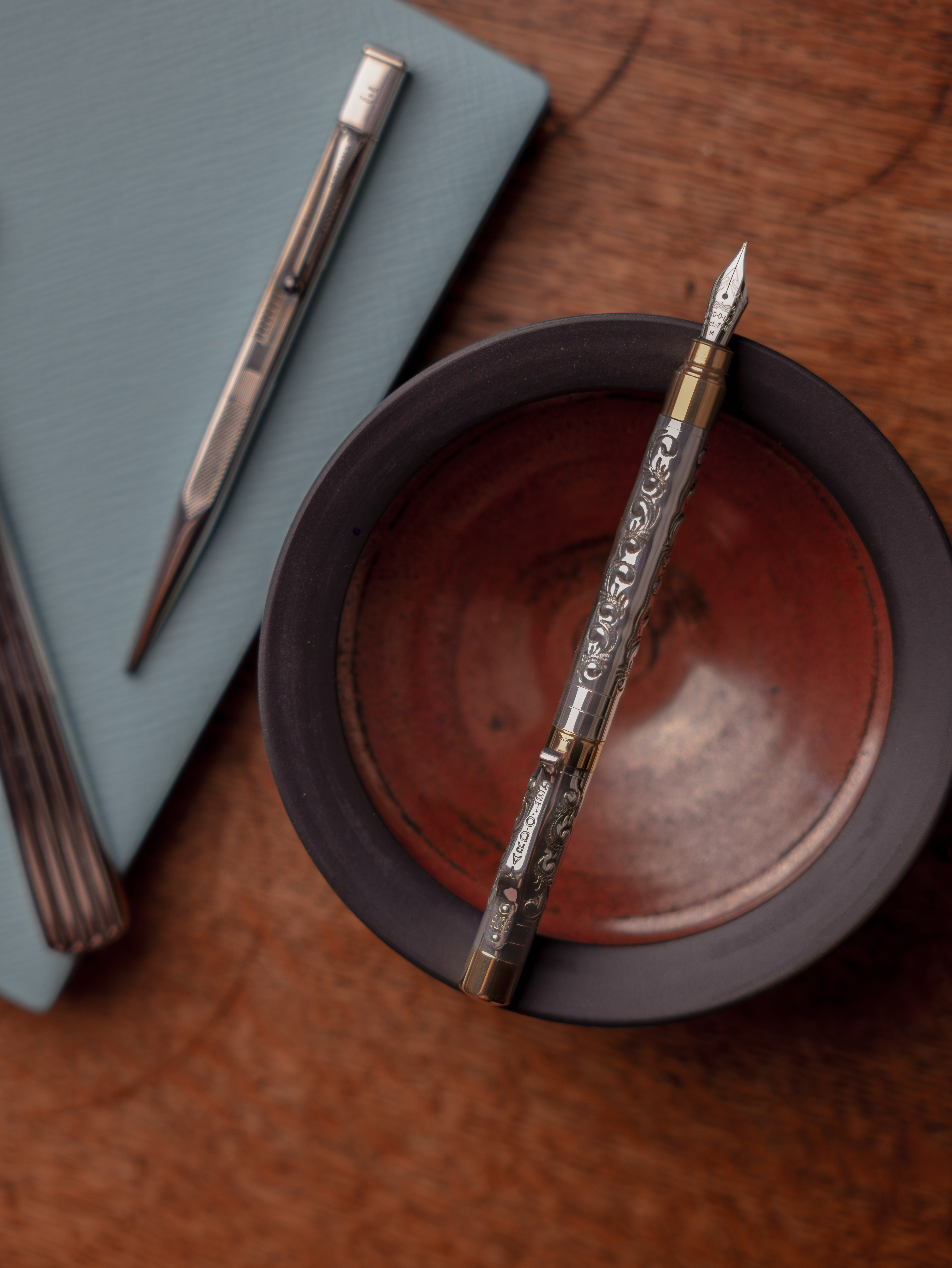
The design of the Pocket is very slender, as one might expect. At first glance, one could be forgiven for thinking this pen was manufactured in the 19th century; the Victorian pattern is a great indicator of the paisley designs that were popularised during that era. But as we delve under the hood and marvel at the 18k gold nib, we can start to see some modernisation with the more contemporary looking stamping.
Focusing on the chased design for a moment, we can clearly see the artist’s intent in the crafting of this pen. The depth of the pattern is not only visually striking, but it also acts as a grip for those with larger hands. While this may not have been the original intention, it is worthy of note nonetheless.

Chasing is an ancient technique dating back thousands of years, yet it is still practiced in much the same way today. Tools such as steel punches, chisels, and hammers are used to bring the metal to life. Craftsmen and women apply their honed skills by delicately tapping their instrument of choice into the material, purposefully transforming each piece into a work of art.
What I find particularly impressive is the price. Today we are seeing a huge increase in prices from Japan, and honestly I feel this has if not will cause people to look elsewhere. Of course, 695 pounds is not cheap for a pen, but when one factors in the cost of raw material, small manufacturing, skilled craftsmen and woman, plus a new flagship store in a prime location of London, this all sums up to a very good price. Of course, you can save 100 pounds by snagging yourself a barley or honeycomb finish, both of which are really stunning options.
Then comes the cherry on top: those precious hallmark stampings. We are presented first with YOL, representing Yard O Led, followed by 925, the international standard for sterling silver. Then we have the Anchor, which is the mark of the Birmingham Assay Office. Next is the Lion Passant—the British guarantee of Sterling Silver. This symbol dates back to the reign of Henry VIII, though interestingly, the lion was facing a different direction in those early days. Finally, we have the date letter, which tells us exactly when the pen was marked.
Now there is an interesting story about the Anchor and Crown, but if you want the full details, you have to pop into the store or ask Molly from the team who will tell you how that anchor came into being!
What’s it like to write?
Writing with the Pocket won’t be for everyone; it is a small pen, and consequently, those with larger hands may be better suited to the Standard or Grand models. Still, if you have small to mid-sized mitts, it is a fantastic writer. The weight of the sterling silver adds confidence to the writing experience without being fatiguing. Furthermore, the length of the pen when posted—via their new screw-back threading—transforms what appears to be a deceptively short pen into a full-sized instrument.

On the subject of the screw threads, I am not entirely sold. While part of me sees this as a more secure way of writing, it somewhat interrupts the design of what is otherwise a very sleek pen. Still, at least I know the cap won’t be flying off any time soon! Sometimes form has to follow function.
The 18k nib is pure class, offering a nicely controlled experience with a touch of softness. However, I would not encourage you to press too hard, as the feed will struggle to keep up. Other than that, the pen glides effortlessly over the page like a duck to water.

Final thoughts
In summary, this is quite the pen. It is an instrument steeped in tradition through honest craftsmanship, and one that simply looks stunning. While the compact size might not suit every hand, and the new screw-threads /brass elements may be a point of contention for purists, the overall package is undeniable.
This value is only further reinforced by the rising costs of other pens in the market. In this price range, you could opt for a Montblanc 146 or a Pelikan M800—both of which offer resin (plastic) bodies and gold nibs. Now, please do not think I am being condescending; these are great pens with superb brand recognition. But when you consider that for the same money, you have the option of acquiring true craftsmanship—an 18k nib and an entirely handmade sterling silver body—it certainly gets one thinking.
In a world where manufacturing is increasingly automated and anonymous, holding a pen that has been hand-chased and hallmarked in Birmingham feels genuinely special. It acts as a bridge between the Victorian past and the modern day, and at £695, it represents a commitment to artistry that is becoming all too rare. For me, that makes it worth every penny—and a permanent addition to my collection.

Condividi:
- Share on X (Opens in new window) X
- Share on Facebook (Opens in new window) Facebook
- Share on WhatsApp (Opens in new window) WhatsApp
- Share on LinkedIn (Opens in new window) LinkedIn
- Share on Pinterest (Opens in new window) Pinterest
- Share on Telegram (Opens in new window) Telegram
- Email a link to a friend (Opens in new window) Email
Leave a Reply